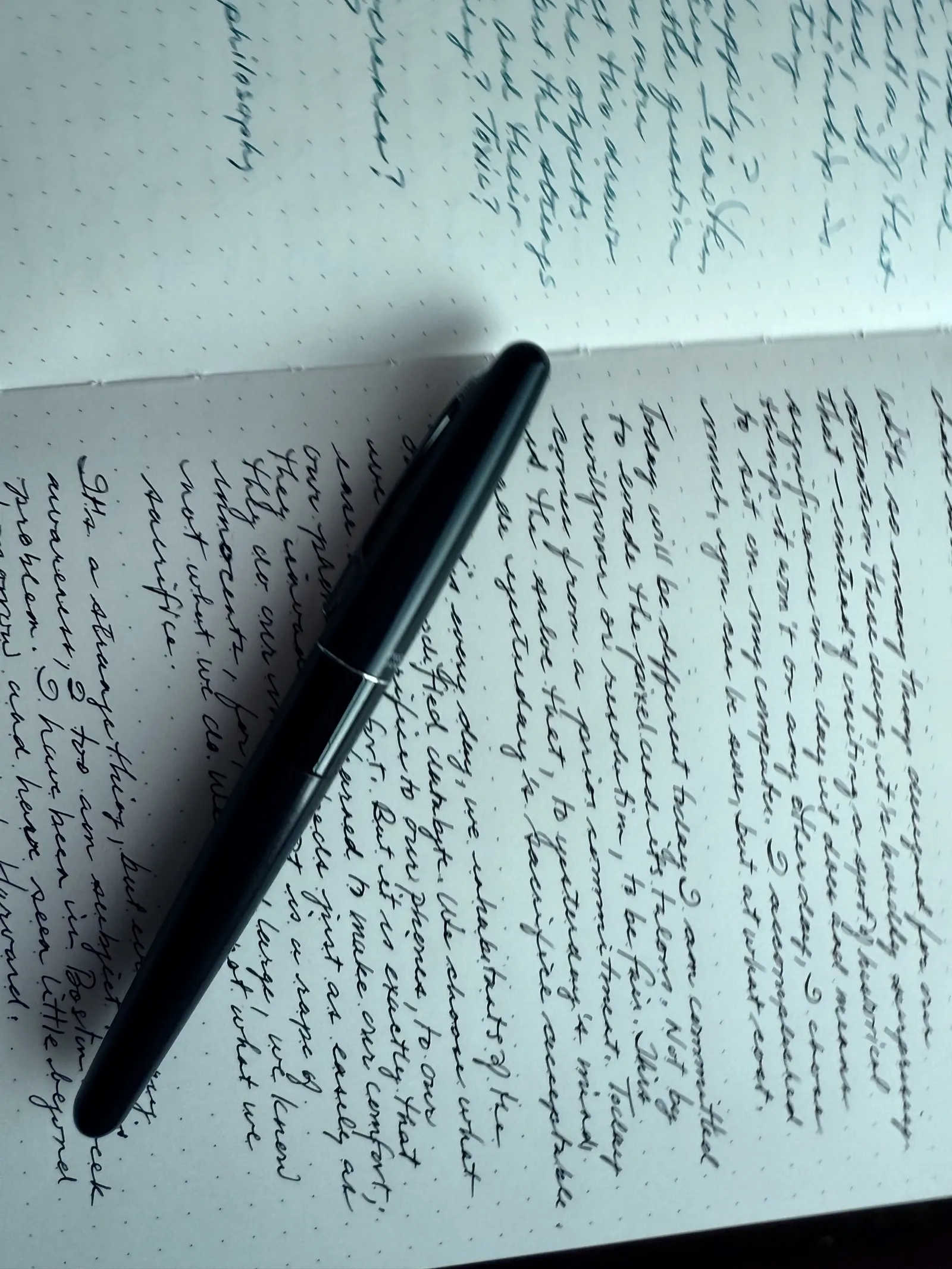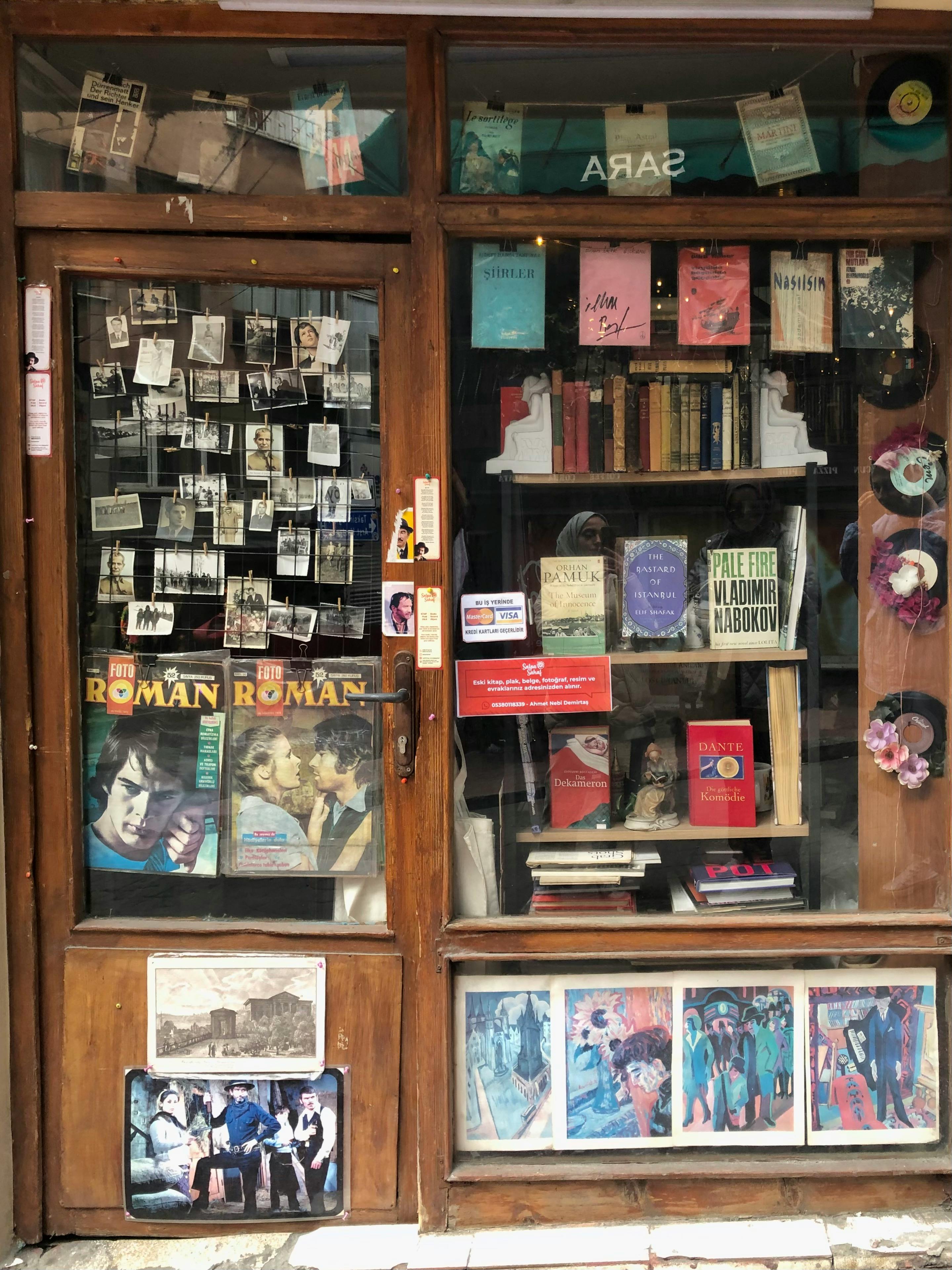
Here’s what usually happens when academics like me read books:
We sit in our offices. We have our favourite chair, our good lighting, our coffee mug within reach. We read books in our field: the ones we’re “supposed” to read, the ones that count for our research. We read the same kinds of stories, by the same kinds of authors, making the same kinds of assumptions about how stories work.
It’s comfortable. It’s professional. It’s also a problem.
Because comfort makes you lazy. Not physically lazy, intellectually lazy. When everything feels familiar, you stop noticing your own assumptions. You stop questioning whether the way you read is the only way to read. You start thinking your perspective is universal, natural, just “how things are.”
I do that. But I also do something different.
In June I will read Yoko Tawada’s The Memory Police on a train from Copenhagen to Aarhus, watching Danish countryside blur past the window. In July I will read the same book, this time in a Lisbon café, jet-lagged and disoriented. I’m currently reading it in my Hamilton office, ensconced in the rhythms of Canadian academic life.
The book changes each time. Or rather, I change. The novel is about a place where things disappear and people forget they ever existed, and it hits differently when you’re the one displaced, when your sense of place is already unstable.
This is an experiment I’m calling the Cross-Cultural Reading, and it’s based on a specific kind of critical practice called secular criticism.
The Homeless Critic
In 1952, literary scholar Erich Auerbach wrote an essay with a strange title: “Philology and Weltliteratur.” He’d just finished writing Mimesis, one of the most influential books in literary studies, and he was reflecting on how he’d done it.
The circumstances mattered. Auerbach was a German-Jewish scholar who’d fled the Nazis in 1936. He ended up in Istanbul, teaching at a university whose library had almost no European literature. Everything he’d relied on—his books, his colleagues, his familiar academic infrastructure—was gone.
You’d think this would make it impossible to write about Western literature. But Auerbach said the opposite: “It is quite possible that the book owes its existence to just this lack of a rich and specialized library.”
Being displaced, being away from home, gave him something he couldn’t have gotten in a German university surrounded by every resource: critical distance.
Edward Said, writing about Auerbach thirty years later, picked up on this. He argued that Auerbach represented a particular kind of intellectual consciousness, something Said called “secular criticism.” It depended on being somehow out of place. Not comfortable, not settled, not fully at home.
Said quoted a medieval writer Auerbach loved, Hugo of St. Victor: “The man who finds his homeland sweet is still a tender beginner; he to whom every soil is as his native one is already strong; but he is perfect to whom the entire world is as a foreign land.”
That last stage—treating the world as foreign—sounds bleak. But it’s not about misery. It’s about refusing to get so comfortable that you stop questioning your assumptions. It’s about cultivating what Said called “oppositional” consciousness: being in the world but maintaining critical distance from its orthodoxies.
Said used a striking phrase for this: he said our “philological home is the earth; it can no longer be the nation.” We can’t read from some neutral, universal position. We’re always reading from somewhere. We’re shaped by nationality, language, education, all the institutions that formed us. But we can resist letting that somewhere become an invisible, unquestioned home.
The Ivory Tower Problem
I teach at York University in Toronto. I’m finishing a PhD in English. My research compares Western narrative theory with Japanese philosophy, examining how post-apocalyptic fiction creates coherent imaginary worlds.
This work happens almost entirely inside what people call the ivory tower. And towers, by definition, are:
- High up (removed from daily life)
- Enclosed (mostly you talk to other people in towers)
- Defensible (outsiders stay out)
- Expensive (not everyone gets in)
The Western university pretends to study “humanity” universally, but it’s a particular institution with a particular history. It grew out of European colonialism. It operates in European languages. It treats European and North American texts as central and everything else as peripheral, exotic, niche.
I’m deeply implicated. I’m a white Canadian settler. My family’s presence here depended on Indigenous displacement. I was educated in institutions that taught me to read using frameworks developed by German, French, and Anglo-American theorists. Even studying Japanese philosophy, I’m doing it through English translations, for a Western degree, using concepts I learned from European thinkers.
I can’t escape these facts. But I can refuse to take them as natural, as just “how things are.”
Travel as Method
So here’s what I’m trying: using travel as an occasion for displaced reading. This sounds all very la-tee-dah, I’m sure, but conference travel is a very real (and financially burdensome) aspect of academic life.
When I travel to Portugal, to Denmark, to Japan, I’m working, and I’m disoriented. Nine times out of ten I’m dealing with a different language, different rhythms, different assumptions about how public space works, how conversations work, how time works. I’m constantly reminded: you’re not at home here.
This disorientation is usually something you try to minimize. You find the familiar (a Starbucks, English-language signs, other tourists). You create little bubbles of home in foreign places.
In the reading lab does the opposite. I lean into displacement. I ask: what happens when I read while I’m already off-balance? What do I notice that I wouldn’t notice in my office?
What Displacement Reveals
Your body becomes visible. In my office, reading is frictionless. Good chair, good light, coffee nearby. I disappear into the text. But reading on a Portuguese train, struggling with announcements I don’t understand, hyperaware I might miss my stop … I can’t disappear. I’m a physical person, in a physical situation, doing something material. Reading isn’t pure communion with universal meaning. It’s an activity I’m performing, right now, right here.
Your assumptions surface. Reading Yoko Tawada in Japan feels different than reading her in Canada. Not because I suddenly “understand Japanese culture.” I don’t. But because in Japan, my foreignness is obvious. I’m the one who doesn’t speak the language, doesn’t know the references, doesn’t get the jokes. Tawada’s novels, which often feature characters who are linguistically displaced, living between languages, suddenly feel less abstract. The experience of reading-as-translation—always reaching for meaning that stays slightly out of reach—becomes concrete.
The universalist illusion cracks. Western literary theory often speaks as if it’s describing how stories universally work. But that’s not true. It’s describing how stories work in a particular tradition, using particular conventions. When I read Japanese fiction that doesn’t follow Western narrative expectations (no clear protagonist, no linear plot, no resolution), my training whispers: “This is slow, nothing’s happening.” But that’s my limitation, not the text’s failure. Displacement helps me see the edges of my own frameworks.
What This Isn’t
The reading lab isn’t about becoming an expert in other cultures. That’s the tourist fantasy: spend two weeks somewhere, read the right books, now you understand.
I’m not trying to master Japanese literature or Portuguese literature or Danish literature. I’m trying to defamiliarize my own reading habits. I’m using other texts to expose the assumptions I’ve naturalized, the things I think are universal that are actually culturally specific.
This matters because of how power works in literary studies. The Western canon, Western theory, Western institutions—they present themselves as universal, as just “literature” and “theory.” Everything else is marked: African literature, Asian literature, Indigenous literature. The marking is the power move. It says: we are the center, you are the periphery.
Secular criticism resists this by insisting: there is no neutral center. Everyone’s reading from somewhere. The question is whether you’re willing to acknowledge it.
Practical Mechanics
Here’s what I actually do:
Before travel: I choose books that have some relationship to where I’m going. Not necessarily about that place, but from that place, or dealing with themes of displacement, translation, cultural crossing. For Lisbon: Portuguese writers in translation. For Copenhagen: Scandinavian fiction. For Japan: contemporary Japanese novels.
After reading: I write field notes. Not polished analysis—just observations. What did I notice? When did I feel confused? What assumptions surfaced? How did location shape attention?
After travel: Back in my office, I reread the same texts. What’s different? What felt obvious abroad that I’m missing now? What feels clearer with distance?
I will post the thoughts and findings that emerge from that process here. Maybe someday I’ll write a book about it. Probably not. That’s not the point. Thinking is.
The Advantages
Intellectual humility. When you’re physically out of place, it’s easier to remember you’re intellectually out of place too. You’re less likely to mistake your perspective for the universal view.
Resistance to disciplinary orthodoxy. Every academic field develops blind spots. Displacement makes orthodoxy visible. You think: wait, why do we read this way? Who decided these were the important questions?
Attention to power. Said insisted secular criticism is always political. Not partisan, but aware of how power shapes what we read, how we read, what counts as “literature.” When you’re traveling, these power dynamics are harder to ignore. You’re navigating systems you didn’t build, languages you don’t speak, histories you’re implicated in.
Better comparative work. I’m supposedly doing “comparative” research. But real comparison requires recognizing incommensurability, the places where things don’t translate cleanly. Displacement helps me see those gaps.
Copenhagen, June 2026
I’ll be presenting at a world literature conference in Aarhus this summer. The paper is about how post-apocalyptic fiction handles the problem of narrative continuity when the world itself is discontinuous. Standard academic stuff.
But I’m also treating the trip as a reading lab session. I’ll be reading Scandinavian fiction (probably Andersen or Knausgård) in Scandinavian spaces, paying attention to how context shapes interpretation. I’ll write about it on Readist. Not as polished scholarship but as field notes from the experiment.
That’s it. That’s the lab. Go places. Read things. Feel uncomfortable, and write about what that experience brings into focus.
That’s what secular criticism demands: not systematic theory, not comprehensive explanation, but occasional insights from a specific position. Not “here’s how narrative universally works,” but “here’s what I noticed, from where I stood, at this particular moment.”
The Long Game
The reading lab won’t solve the structural problems of literary studies. It won’t decolonize the academy or fix the Western canon’s dominance. Those require collective institutional change, not individual reading practices.
But it does something smaller and maybe more sustainable: it cultivates a habit of critical consciousness. It practices displacement as method. It resists the comfort that makes you stop questioning.
Said wrote that criticism should be “life-enhancing and constitutively opposed to every form of tyranny, domination, and abuse.” That sounds grandiose until you realize: every form of domination depends on people getting comfortable with it, on assumptions becoming invisible.
Displacement keeps assumptions visible. Travel makes you a stranger. Being a stranger makes you notice.
The question isn’t whether you read from a limited perspective. You do. Everyone does.
The question is whether you’re willing to keep noticing that limitation—to practice, as Hugo of St. Victor said, treating the world as foreign land. Not because foreignness is inherently good, but because it’s the opposite of the comfort that lets you forget you have a perspective at all.
Further Reading
If you’re curious about the ideas behind this:
Edward Said, The World, the Text, and the Critic (1983): The book where Said lays out his vision of secular criticism. Dense but rewarding.
Erich Auerbach, Mimesis (1946): The book written in exile. Auerbach reads passages from Homer to Virginia Woolf, showing how Western literature has represented reality. The epilogue about writing it in Istanbul is especially moving.
Hugo of St. Victor, Didascalicon (c. 1127): A medieval guidebook for students. Book III contains the famous passage about exile and wisdom.
Raymond Williams, The Country and the City (1973): Williams reads English literature by asking: what social relationships are hidden in these descriptions of rural beauty? A great model for worldly reading.
But honestly, the best way to understand secular criticism is to try it.
Pick up a book. Leave your house.
See what you notice.